Introducing Agentic Visibility Score: Measure How Ready Your Products Are for AI Discovery
Discover how AVS measures product readiness for AI discovery, comparison, and recommendation.

Introducing Agentic Visibility Score: Measure How Ready Your Products Are for AI Discovery
AI is changing how people discover products.
For years, ecommerce brands have focused on traditional search engine optimization to improve rankings, attract organic traffic, and help customers find product pages.
That still matters.
But the way people search is expanding.
Instead of typing a short query into a search engine and opening multiple results, shoppers are increasingly asking AI assistants questions such as:
- What is the best product for my needs?
- Which option offers the best value?
- Is this product suitable for a specific use case?
- How does this compare with competing products?
- What should I buy under a particular budget?
- Which product would you recommend and why?
AI systems do not simply return links. They interpret the question, gather information, compare options, summarize findings, and may directly recommend specific products.
That creates a new challenge for ecommerce brands:
Is your product page giving AI enough information to understand, evaluate, and recommend your product?
That is the question Agentic Visibility Score — AVS — is built to answer.
What is Agentic Visibility Score?
Agentic Visibility Score is a product-level AI visibility analysis platform that evaluates how ready an ecommerce product page is to be discovered, understood, compared, cited, and recommended by AI-driven search and shopping experiences.
AVS analyzes an individual product page and evaluates the signals that can influence how effectively AI systems understand that product.
Instead of only asking:
Can Google crawl this page?
AVS asks a broader set of questions:
- Can AI understand exactly what this product is?
- Does the page answer the questions potential buyers are likely to ask?
- Are important specifications, features, benefits, and use cases clearly explained?
- Can an AI system confidently compare the product with alternatives?
- Does the page provide enough supporting information to make a recommendation?
- Is the product information structured in a machine-readable way?
The result is an Agentic Visibility Score, supported by detailed findings and actionable recommendations.
Why traditional SEO is no longer the full picture
Traditional SEO primarily focuses on helping search engines discover, index, and rank webpages.
Typical optimization areas include:
- Keywords
- Titles
- Meta descriptions
- Internal linking
- Backlinks
- Structured data
- Page speed
- Crawlability
These signals remain important.
But AI-driven discovery requires something additional.
An AI assistant trying to recommend a product may need to understand:
- What the product does
- Who it is for
- What problems it solves
- Its key features
- Its benefits
- Materials or ingredients
- Dimensions and specifications
- Usage instructions
- Compatibility
- Safety considerations
- Reviews and ratings
- Warranty or guarantee information
- Product variants
- How it differs from competing options
A product page can therefore be technically optimized for SEO while still providing insufficient information for AI-driven recommendation.
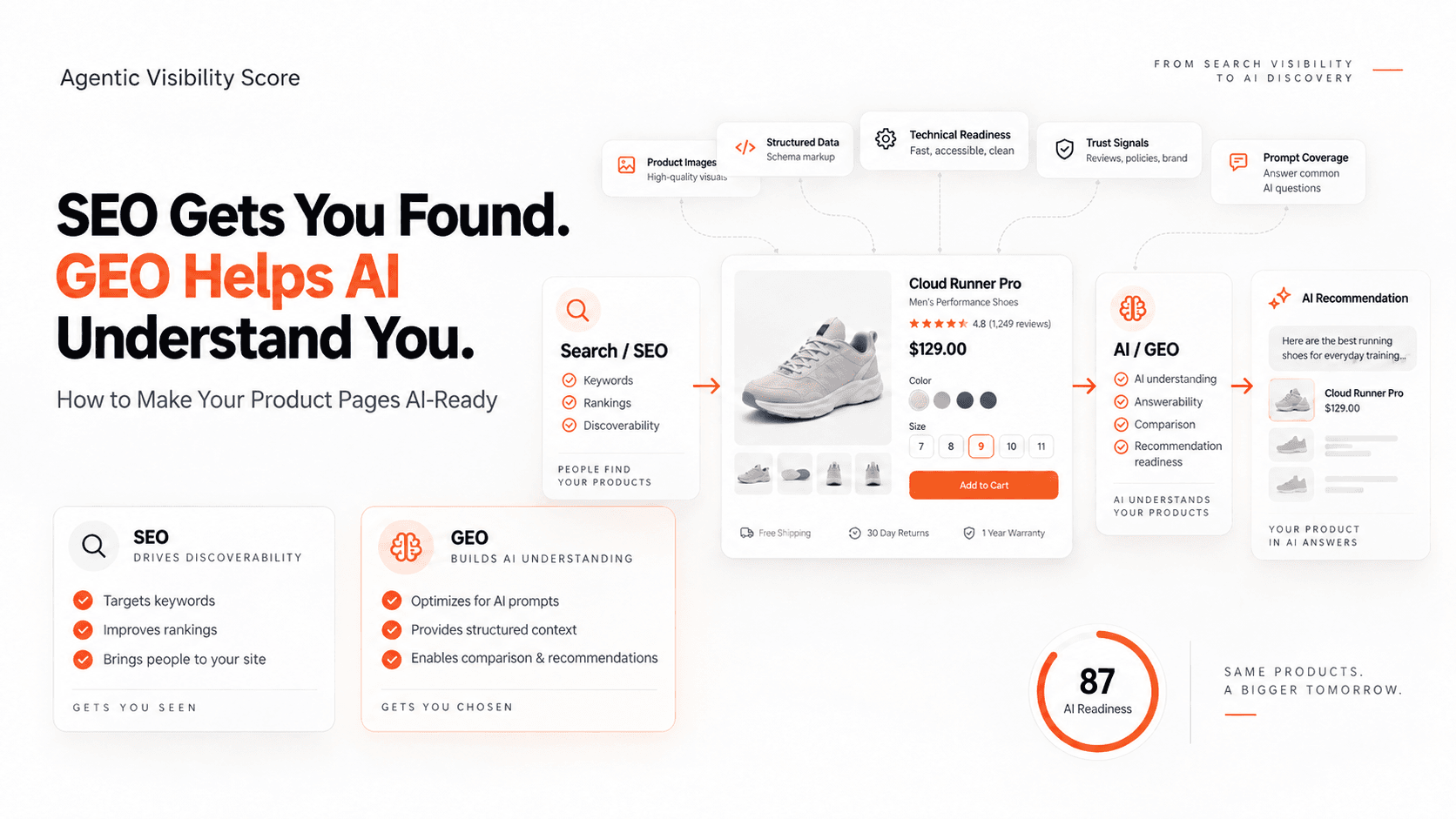
This is where Generative Engine Optimization, or GEO, becomes increasingly important.
SEO helps you get found. GEO helps AI understand you.
The objective of GEO is not to replace SEO.
It is to extend optimization into AI-powered discovery environments.
SEO helps improve visibility in traditional search.
GEO focuses on whether generative AI systems can:
- Retrieve your product.
- Understand it.
- Compare it.
- Trust the available information.
- Use it when answering a shopper's question.
- Potentially cite or recommend it.
AVS helps ecommerce teams identify where their product pages are strong and where important gaps may be limiting that readiness.
What does AVS analyze?
AVS evaluates several dimensions of a product page to create a comprehensive picture of its AI readiness.
1. Buyer Prompt Coverage
AI shopping experiences start with questions.
A shopper may never search for the exact product name. Instead, they may describe a need.
For example:
“What is the best mattress for a side sleeper who gets hot at night?”
“Which running shoe is suitable for flat feet?”
“What is a good decorative gift under $100?”
AVS evaluates likely buyer prompts related to the product and identifies whether the product page contains enough information to answer them.
Prompts can fall into areas such as:
- Product suitability
- Specifications
- Features
- Benefits
- Usage
- Safety
- Comparison
- Compatibility
- Value
- Trust
- Purchase considerations
Missing Prompts
These are important buyer questions that the available product content does not adequately answer.
They represent opportunities to strengthen the page with useful, relevant information.
Covered Prompts — Needs Improvement
These prompts are addressed, but the available answer may be incomplete, unclear, poorly structured, or lacking supporting detail.
Instead of simply telling a brand that its content is weak, AVS helps identify what information a potential AI-assisted shopper may still need.
2. Product Content Quality
Having a long product description does not necessarily mean a product page is AI-ready.
AVS evaluates whether important product information is clearly available across areas such as:
- Product title
- Meta title
- Meta description
- Product description
- Features
- Benefits
- Specifications
- Materials or ingredients
- Usage instructions
- Product details
- Reviews
- Trust signals
The objective is not to add content for the sake of adding content.
The objective is to provide clear, factual, decision-useful information that helps both shoppers and machines understand the product.
For example, saying:
“Designed with premium materials for superior performance.”
may sound appealing.
But an AI system may still need to know:
- What materials?
- What makes them premium?
- What performance benefit do they provide?
- For which customer or use case?
- Is there evidence supporting the claim?
AVS helps identify these information gaps.
3. Structured Product Data
AI systems do not only interpret visible text.
Machine-readable product information can also help systems identify key details accurately.
AVS evaluates structured-data signals such as:
- Product
- Offer
- Brand
- Review
- AggregateRating
- Variant
Structured data can provide explicit information about:
- Product name
- Brand
- Price
- Availability
- SKU
- Ratings
- Reviews
- Offers
- Variants
A page may display this information visually while failing to expose it clearly in structured form.
AVS helps highlight where the machine-readable representation of the product can be improved.
4. Technical Discoverability
Strong content is only valuable if it can be accessed.
AVS evaluates technical signals that may influence product discoverability, including areas such as:
robots.txtllms.txt- XML sitemap availability
- Page accessibility
- Performance-related signals
The important distinction is that:
Presence does not automatically mean correct implementation.
Having a robots file, sitemap, or structured data does not automatically mean the configuration is useful.
AVS focuses on whether these signals actually support product accessibility and machine understanding.
5. Product Images
AI systems are becoming increasingly multimodal.
Images therefore represent another important layer of product information.
AVS can evaluate factors such as:
- Image availability
- Image variety
- Product visibility
- Alt text
- Product angles
- Contextual images
- Educational images
- Variant representation
Consider the difference between a product page containing one basic product image and another containing:
- Front and back views
- Dimensions
- Product-in-use photography
- Feature callouts
- Packaging
- Size comparisons
- Variant imagery
The second page provides substantially more information that both shoppers and multimodal AI systems can potentially use to understand the product.
The AVS Score
AVS combines the evaluated signals into a score out of 100.
The score is designed to represent:
How well the product currently satisfies the measurable AI-readiness criteria evaluated by AVS.
It is important to understand what the score does — and does not — mean.
A high AVS score does not guarantee that ChatGPT, Gemini, Copilot, or another AI platform will recommend a product.
Third-party AI platforms use their own models, retrieval systems, sources, ranking logic, and continuously evolving algorithms.
AVS therefore measures readiness, not guaranteed placement.
A higher score indicates that the product page provides stronger signals for AI understanding and recommendation readiness under the current AVS framework.
The real value is not the score. It is knowing what to fix.
A score without explanation is not particularly useful.
That is why AVS is designed to go beyond:
Your score is 68/100.
Instead, AVS identifies the specific issues affecting the product's readiness.
Recommendations may include actions such as:
- Add missing product specifications
- Improve feature descriptions
- Explain customer benefits more clearly
- Add missing usage instructions
- Address high-value buyer questions
- Improve schema implementation
- Add stronger trust signals
- Improve product imagery
- Add comparison-ready information
- Improve technical discoverability
This gives ecommerce teams a practical roadmap rather than simply another dashboard metric.
Why AVS evaluates individual products
Many AI visibility platforms focus primarily on brand-level visibility.
They help answer questions such as:
How often is my brand mentioned by AI?
That is useful.
But ecommerce purchasing decisions are often much more specific.
Consumers ask questions about individual products.
They want recommendations based on:
- Price
- Use case
- Features
- Specifications
- Compatibility
- Quality
- Reviews
- Personal requirements
A brand may have strong overall recognition while individual product pages remain difficult for AI systems to evaluate.
This is why AVS focuses on product-level visibility.
It helps identify whether the individual product or SKU provides enough information to participate effectively in AI-assisted purchasing decisions.
Who is AVS for?
AVS is designed for teams working across ecommerce growth and product visibility.
Ecommerce brands
Evaluate whether individual product pages are ready for AI-driven discovery and recommendation.
SEO and GEO teams
Extend optimization beyond traditional rankings into generative search and AI commerce.
Ecommerce managers
Identify gaps across product catalogs and prioritize products requiring improvement.
Content teams
Understand which questions, specifications, and product details customers — and AI systems — may need.
Product managers
Evaluate whether product information communicates sufficient value, differentiation, and evidence.
Agencies
Provide ecommerce clients with structured AI-readiness audits and actionable recommendations.
Developers
Identify structured-data and technical discoverability issues that content teams cannot solve alone.
What happens after implementing AVS recommendations?
An AVS analysis should not be treated as a one-time score.
The intended workflow is:
Analyze → Improve → Re-analyze → Measure
For example:
A product might initially receive:
AVS Score: 62
The brand then implements recommendations such as:
- Adding detailed specifications
- Improving FAQs
- Adding use-case content
- Strengthening structured data
- Improving image information
The product can then be analyzed again.
A new score of:
AVS Score: 81
provides a measurable indication that the product has become stronger against the AVS readiness framework.
Over time, AVS aims to expand beyond readiness measurement into tracking how products actually perform across AI discovery environments.
The future of ecommerce discovery is increasingly agentic
Traditional ecommerce discovery required shoppers to do much of the work.
Search.
Open several pages.
Read descriptions.
Compare products.
Evaluate reviews.
Choose an option.
AI assistants can increasingly perform parts of that process on behalf of the customer.
A shopper can describe what they need and expect the AI system to find, evaluate, and recommend suitable products.
That changes what it means to compete for visibility.
The goal is no longer only:
Get my page into the search results.
It is increasingly:
Give AI enough reliable information to confidently include my product in the answer.
Is your product ready for AI discovery?
The shift toward AI-assisted commerce has already begun.
Brands that prepare their product information today will be better positioned as AI becomes a more important layer of product discovery and purchasing.
Agentic Visibility Score gives ecommerce teams a practical starting point.
It helps answer one fundamental question:
How ready is this product to be understood and recommended by AI?
And, more importantly:
What should we improve next?
Analyze your product with AVS and discover how ready it is for the next generation of ecommerce search.