SEO vs GEO for Ecommerce: How to Make Your Product Pages AI-Ready
Learn how SEO and GEO work together to improve ecommerce product readiness for AI discovery.
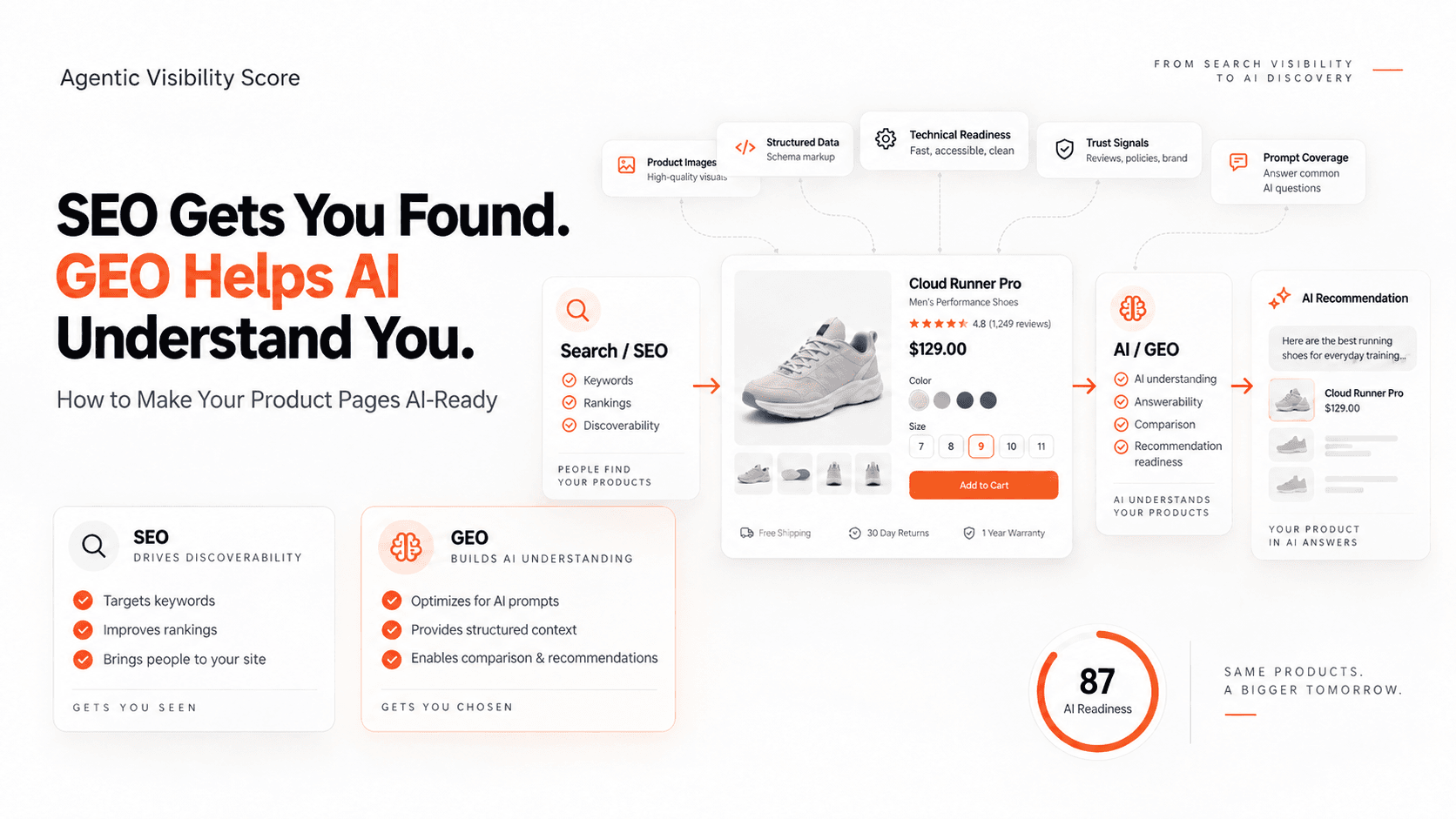
SEO vs GEO for Ecommerce: How to Make Your Product Pages AI-Ready
For years, ecommerce teams have optimized product pages with one primary goal:
Rank higher in search engines.
That still matters.
But product discovery is changing.
Shoppers are increasingly using AI assistants and conversational interfaces to research products, compare options, understand specifications, evaluate alternatives, and narrow down buying decisions.
Instead of searching:
“best rose quartz bracelet”
a shopper might ask:
“Which rose quartz bracelet would be suitable as a gift, fit a smaller wrist, and come with authenticity information?”
That creates a different optimization challenge.
A product page may contain enough information to rank for a keyword, but not enough information for an AI system to confidently answer detailed buyer questions.
This is where Generative Engine Optimization — GEO — becomes important.
What Is SEO?
Search Engine Optimization focuses on helping search engines discover, understand, index, and rank webpages.
For ecommerce product pages, SEO commonly includes:
- Product titles
- Meta titles and descriptions
- Relevant keywords
- Internal linking
- Page performance
- Structured data
- Canonical URLs
- Crawlability
- Product descriptions
- Image optimization
These signals remain fundamental.
Good SEO makes it easier for search engines to discover and interpret a product page.
But AI-driven product discovery introduces another layer.
What Is GEO?
Generative Engine Optimization (GEO) focuses on making information easier for generative AI systems to retrieve, understand, interpret, compare, and use when answering questions.
For ecommerce, this means thinking beyond:
“Can a search engine index this product?”
and asking:
“Can an AI system confidently understand what this product is, who it is for, how it differs, and whether it answers the shopper's question?”
That requires richer product information.
SEO Gets You Found. GEO Helps AI Understand You.
SEO and GEO are not replacements for one another.
They complement each other.
A strong ecommerce strategy increasingly requires both.
| SEO | GEO |
|---|---|
| Focuses on search engines | Focuses on AI-driven discovery |
| Targets keywords and search intent | Targets buyer questions and conversational intent |
| Helps pages rank and get discovered | Helps AI understand and evaluate product information |
| Optimizes metadata and page structure | Optimizes completeness, context, and answerability |
| Measures rankings, impressions, and clicks | Measures AI readiness, prompt coverage, and information gaps |
The objective is not to stop optimizing for Google.
It is to ensure the product information that search engines discover is also useful enough for AI systems to work with.
Why Product-Level GEO Matters
Many AI visibility tools look at a brand.
But ecommerce decisions happen at the product level.
A customer rarely asks an AI assistant simply:
“Is Brand X good?”
They increasingly ask detailed questions such as:
- Which product is better for my needs?
- What size should I choose?
- Is this product safe for daily use?
- What material is it made from?
- Does it have a warranty?
- How does it compare with alternatives?
- What do customers say about it?
- Is it suitable for children?
- Does it require special care?
- What is included in the package?
If your product page cannot answer these questions, an AI system may have limited information available when trying to explain or compare the product.
This is why AVS analyzes individual products and SKUs, rather than only looking at overall brand visibility.
What Does an AI-Ready Product Page Need?
There is no single field that makes a product “AI-ready.”
AI readiness comes from a combination of signals.
1. Clear Product Identity
AI systems should be able to understand exactly what the product is.
Your product page should clearly communicate:
- Product name
- Brand
- Product category
- Purpose
- Material
- Primary features
- Intended audience
- Available variants
Ambiguous product information creates ambiguous answers.
2. Complete Product Specifications
Specifications are especially important for comparison-oriented queries.
Depending on the product, this might include:
- Dimensions
- Weight
- Capacity
- Materials
- Color
- Size
- Fit
- Compatibility
- Power requirements
- Ingredients
- Package contents
For example, describing a bracelet as “stretchable” may not be enough if the shopper asks:
“Will this bracelet fit a 6-inch wrist?”
Specific information creates better answerability.
3. Buyer Question Coverage
Your product description may look complete to a marketing team while still leaving important buyer questions unanswered.
Think about questions covering:
Discovery
“What is the best product for…?”
Research
“How does this work?”
Comparison
“How is this different from…?”
Trust
“Is this genuine?”
Transactional
“How much does it cost and when will it arrive?”
Usage
“How should I use it?”
Safety
“Can I use this every day?”
These questions represent potential AI prompts.
The more useful buyer questions your product page answers accurately, the stronger its information foundation becomes.
4. Structured Product Data
Human-readable content is important.
Machine-readable content is equally important.
Structured data can help systems interpret information such as:
- Product identity
- Brand
- Price
- Availability
- SKU
- Reviews
- Ratings
- Variants
- Offers
For example, a product may visually show:
4.8 stars — 156 reviews
but if the structured data does not properly represent those ratings, machine interpretation may be less reliable.
Structured data should accurately reflect the information visible on the product page.
5. Trust Signals
AI systems are often asked recommendation-oriented questions.
That makes trust information important.
Useful signals can include:
- Product reviews
- Average ratings
- Review counts
- Warranty information
- Certifications
- Authenticity information
- Returns policy
- Shipping details
- Brand information
Consider the difference between:
“Made from premium material.”
and:
“Made from 100% natural rose quartz. Includes authenticity information and a 10-day return policy.”
The second statement gives considerably more context for a buyer—or an AI system—to evaluate.
6. Useful Product Images
Images are no longer only visual merchandising assets.
Modern AI systems can also work with visual information.
A strong image set can show:
- Product appearance
- Scale
- Usage
- Fit
- Different angles
- Packaging
- Variants
- Important features
Image descriptions and alt text should also be meaningful.
Instead of repeating:
product-image
across every image, describe what is actually being shown.
For example:
Rose quartz bracelet worn on wrist showing bead size and fit
That provides additional semantic context.
7. Technical Discoverability
Even excellent content is less useful if crawlers cannot reliably access it.
Important technical foundations include:
- robots.txt
- Sitemap availability
- Page performance
- Indexability
- Accessible product URLs
- Structured data
- Image accessibility
Technical readiness supports the discovery layer underneath both SEO and GEO.
Where AVS Fits
Agentic Visibility Score was built to help ecommerce teams evaluate these product-level signals in one place.
AVS analyzes a product page across areas such as:
Buyer Prompt Coverage
Which important buyer questions does the page answer?
Which questions remain missing?
On-Page Product Content
Are important features, benefits, specifications, usage information, and trust signals available?
Structured Data
Can machines clearly interpret the product, offers, ratings, reviews, and variants?
Technical Readiness
Can the product page and related resources be discovered effectively?
Product Images
Do images provide useful, relevant product information?
Platform-Specific Readiness
How well is the product prepared against AVS's evaluation criteria for major AI ecosystems?
From Score to Action
Knowing that a product page has gaps is only useful if you know what to fix.
That is why AVS doesn't stop at a score.
It identifies prioritized recommendations.
High Impact
- Add missing specifications
- Improve product-specific reviews
- Implement rating schema
- Explain product variants
Medium Impact
- Improve features and benefits
- Add care instructions
- Improve image descriptions
Lower Impact
- Refine metadata
- Improve minor schema attributes
- Strengthen content consistency
This allows ecommerce teams to focus first on the changes expected to have the greatest impact on product completeness and AI readiness.
Analyze. Improve. Re-Analyze.
GEO should not be treated as a one-time optimization exercise.
Products change.
Prices change.
Inventory changes.
Content improves.
Customer questions evolve.
A practical workflow is:
- Analyze the product
Understand its current AI-readiness signals. - Identify gaps
Find missing buyer questions, content, technical, and structured-data issues. - Apply improvements
Update the product page. - Re-analyze
Measure how the product's readiness changes.
This creates a repeatable optimization cycle:
Analyze → Improve → Re-check
Does a High AVS Score Guarantee AI Recommendations?
No.
This distinction is important.
An AVS score measures how well a product satisfies the measurable criteria within the AVS readiness framework.
It does not guarantee that ChatGPT, Gemini, Copilot, or another third-party AI platform will:
- Display the product
- Cite the product
- Rank the product
- Recommend the product
- Place it above competitors
Those decisions are controlled by third-party platforms and can depend on many external signals.
AVS helps ensure that your product information foundation is stronger when AI systems evaluate it.
The Future of Ecommerce Discovery Is Product-Level
Search engines are not disappearing.
Neither are product pages.
What is changing is how customers interact with product information.
A shopper may move between:
Google → AI Assistant → Marketplace → Product Page → AI Comparison → Purchase
Ecommerce teams therefore need product information that works across all of these environments.
SEO helps make the page discoverable.
GEO helps make the product understandable.
And product-level AI readiness helps bridge the two.
Is Your Product Ready for AI Discovery?
AVS analyzes individual ecommerce products to uncover the content, prompt, structured-data, technical, and image gaps that may limit AI readiness.
Get your Agentic Visibility Score, understand what is missing, and see what to improve first.
No credit card required · 10 free product analyses