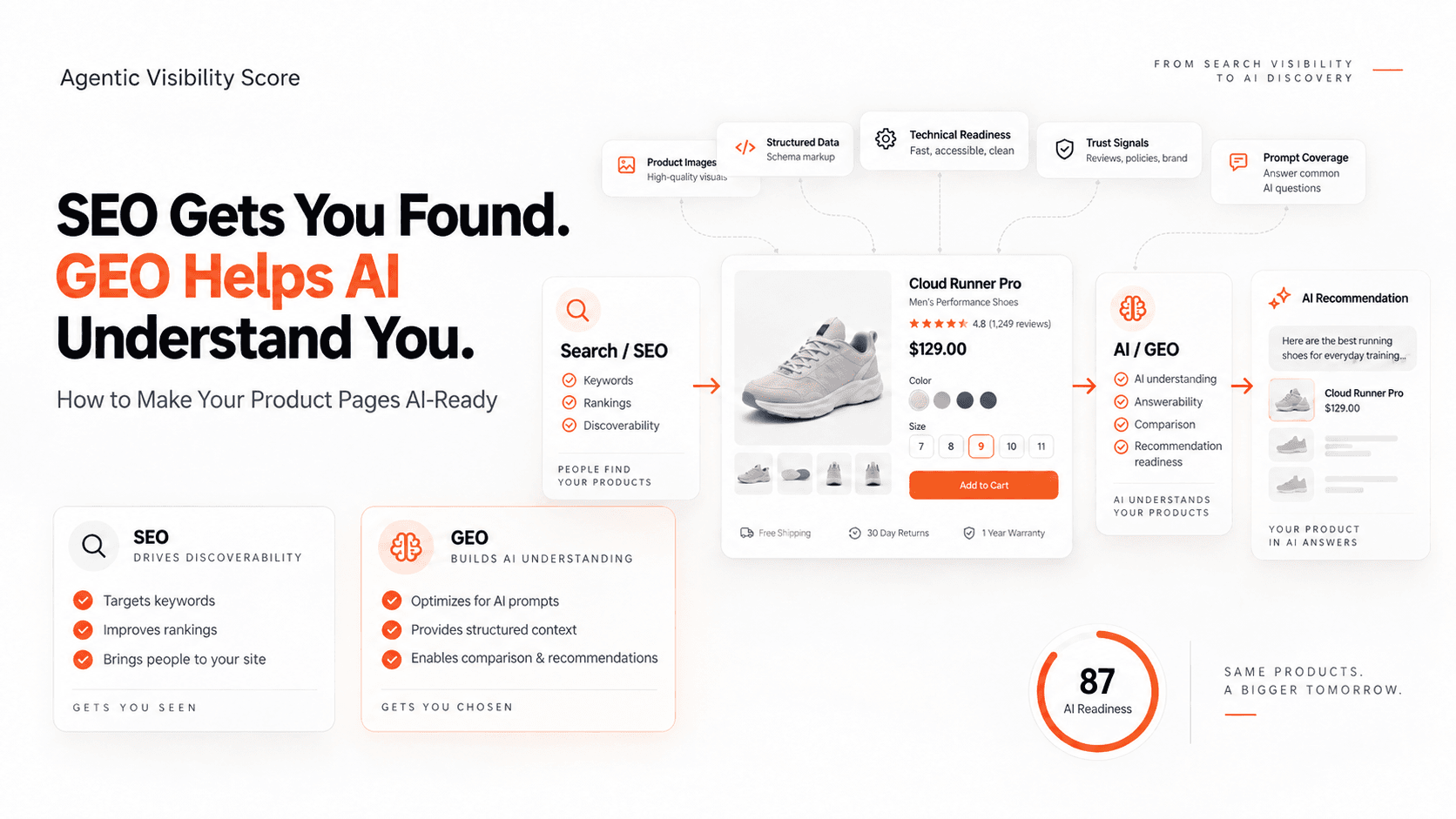
How to Improve Product Visibility in AI Search: A Practical Guide for Ecommerce Brands
Learn how to make product pages easier for AI platforms to understand and recommend.
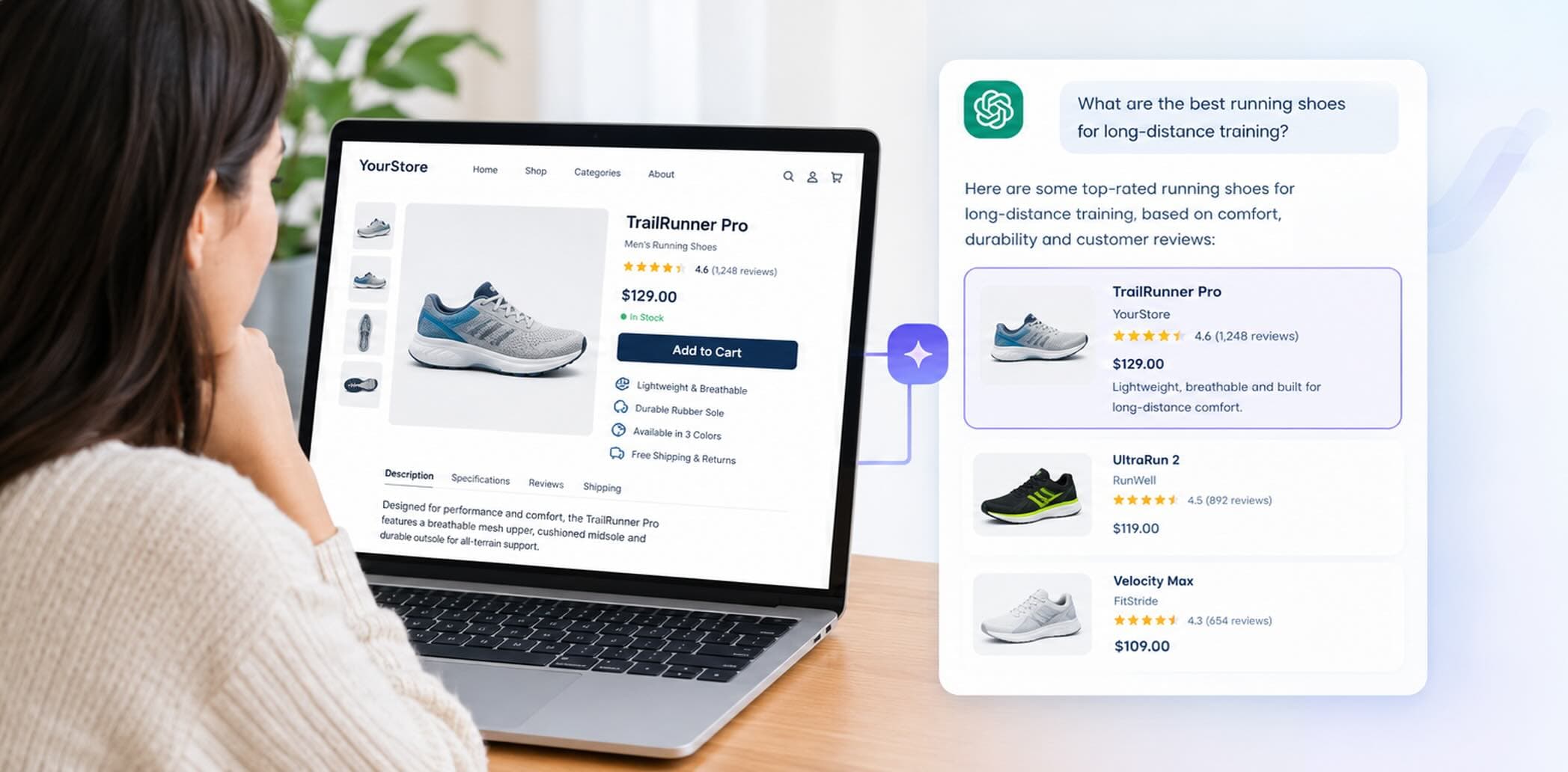
How to Improve Product Visibility in AI Search: A Practical Guide for Ecommerce Brands
Online product discovery is evolving. Customers are increasingly using AI-powered tools to research products, compare alternatives, and find recommendations that match their needs. Instead of relying exclusively on traditional search results, shoppers can ask conversational questions and receive curated product suggestions.
For ecommerce brands, this creates a new challenge: is your product easy for AI platforms to discover, understand, and recommend?
Improving AI search visibility is not about finding a single trick or guaranteeing a position in an AI-generated answer. It is about making product information accurate, accessible, useful, and consistent wherever potential customers might discover it.
What Is AI Search Visibility?
AI search visibility refers to how effectively a brand or product appears in responses generated by AI-powered search and discovery platforms. These platforms may help customers identify suitable products, compare features, evaluate prices, and explore purchase options.
A product can have a well-designed website and still be overlooked in relevant AI responses. Product information may be incomplete, important details may be difficult to interpret, or competing products may provide clearer and more comprehensive information.
Improving visibility starts with understanding what information is available about your products and how accurately AI platforms represent them.
7 Ways to Improve Your Product's AI Search Visibility
1. Make Product Pages Clear and Informative
Your product page should explain what the product is, who it is for, what it does, and why a customer might choose it. Avoid vague descriptions that rely on promotional language without providing useful details.
Include relevant information such as:
- Product name, brand, and category.
- Key features, specifications, dimensions, and compatibility.
- Materials, ingredients, or technical details where applicable.
- Available sizes, colors, models, and variations.
- Pricing, shipping information, return policies, and warranty details.
Write descriptions that help customers make informed decisions. The more clearly a product's characteristics and intended use are explained, the easier it is for people and automated systems to interpret the available information.
2. Use Structured Data to Describe Products
Structured data helps search engines interpret important details about a webpage. For ecommerce websites, relevant Schema.org markup may include Product, Offer, and Review properties when the information is applicable and supported by the page.
Keep your structured data consistent with the information customers can actually see. Product names, prices, availability, ratings, and variant information should be accurate and updated when the underlying information changes.
Structured data is not a guarantee of inclusion in AI-generated recommendations, but it can improve machine readability and support eligible search features.
3. Keep Pricing and Product Availability Accurate
Customers often ask AI platforms to recommend products within a particular budget, compare alternatives, or find an item with specific features. Incorrect prices or outdated availability can make a product less useful to shoppers and create inconsistent information across channels.
Review your product pages, ecommerce catalog, and relevant product feeds regularly. Keep prices, stock status, shipping terms, and product variants aligned wherever the information is published.
For eligible shopping experiences, product information may come from structured metadata, merchant-provided catalogs, and other third-party sources. Accurate and up-to-date information helps reduce avoidable discrepancies.
4. Create Content That Answers Real Customer Questions
Customers rarely search only by product name. They may ask questions such as:
- Which mattress is suitable for side sleepers?
- What is the difference between two similar products?
- Which running shoes are best for long-distance training?
- Is this product compatible with my existing device?
- What should I consider before buying this product?
Build useful buying guides, comparison pages, FAQs, and educational articles around the questions your audience actually asks. Provide direct answers, explain trade-offs, and support product claims with reliable information.
Avoid publishing large volumes of repetitive, generic content simply to target more keywords. Prioritize original, accurate, genuinely helpful information that adds value to the customer's decision-making process.
5. Strengthen Trust With Reviews and Reliable Information
Product discovery involves more than matching a keyword to a product. Buyers want to understand quality, reliability, suitability, and real-world performance.
Where appropriate, make genuine customer reviews, product specifications, warranty information, and relevant certifications easy to find. Ensure review summaries and ratings accurately reflect their underlying sources.
Consistent business information and credible third-party references can also help customers verify product claims. Never fabricate reviews, ratings, endorsements, or product credentials to influence AI recommendations.
6. Ensure Search Engines Can Access Your Important Pages
Important product and category pages should be discoverable through your website's navigation and internal links. Check that your technical setup does not unintentionally block search engines from accessing key content.
Review indexability, canonical URLs, redirects, mobile usability, page performance, and structured data validity. Make sure essential product details are available in a form that can be interpreted reliably, rather than relying entirely on content that may not be accessible to crawlers.
Also review the documented access requirements and policies of the platforms that matter to your business. Different AI systems may have different access methods and limitations.
7. Measure AI Visibility and Track Changes Over Time
Traditional SEO metrics alone may not explain whether AI platforms mention your products when customers ask for recommendations. AI visibility should be evaluated through relevant queries and observed responses across the platforms that matter to your audience.
Start with a consistent set of questions spanning product discovery, category recommendations, feature comparisons, and specific purchase needs. Evaluate:
- Whether your product appears in relevant responses.
- How prominently it is mentioned compared with competing products.
- Whether product descriptions, prices, and features are accurate.
- Which strengths and information gaps may affect product discovery.
- Whether visibility changes after product-page or content updates.
AI responses can vary by query, platform, and context. Repeat your evaluations consistently and treat individual results as observations rather than guarantees of future visibility.
Common AI Search Optimization Mistakes to Avoid
Businesses can waste time on AI visibility efforts when they focus on isolated technical tactics instead of the quality of their product information. Avoid these common mistakes:
- Relying only on keywords: Relevant terminology matters, but it cannot replace clear product information and useful content.
- Ignoring product data quality: Inconsistent prices, missing specifications, and outdated stock information undermine the customer experience.
- Using structured data incorrectly: Markup should accurately represent the page and comply with applicable guidelines.
- Publishing generic AI-generated content at scale: Content should be reviewed for accuracy, originality, and genuine usefulness.
- Assuming one successful test proves visibility: Monitor multiple relevant queries and evaluate results over time.
How Agentic Visibility Score (AVS) Can Help
Improving AI search visibility begins with understanding your current position. Without evaluating how AI platforms interpret and present your products, it can be difficult to identify which gaps deserve attention first.
Agentic Visibility Score (AVS) helps ecommerce brands assess how their products are represented across AI platforms, identify visibility gaps, and uncover opportunities to improve product information and discoverability.
Use an AVS product analysis to build a clearer picture of where your product information performs well and where improvements may be needed. Combine those findings with accurate product data, helpful content, technical improvements, and ongoing measurement.
Explore Agentic Visibility Score (AVS) and start evaluating your product's AI visibility.
Final Thoughts
AI-powered product discovery creates another important opportunity for ecommerce brands to connect with potential customers. Improving visibility requires a practical foundation: clear product pages, accurate pricing and availability, appropriate structured data, trustworthy information, accessible content, and regular evaluation.
There is no single optimization that guarantees an AI recommendation. The better approach is to make your products easier to understand, verify, compare, and evaluate—and then measure whether your improvements are making a difference.