Product FAQs for AI Shopping: How to Write Q&As AI Assistants Can Actually Use
Learn how to write product FAQs that help AI shopping assistants answer buyer questions accurately.
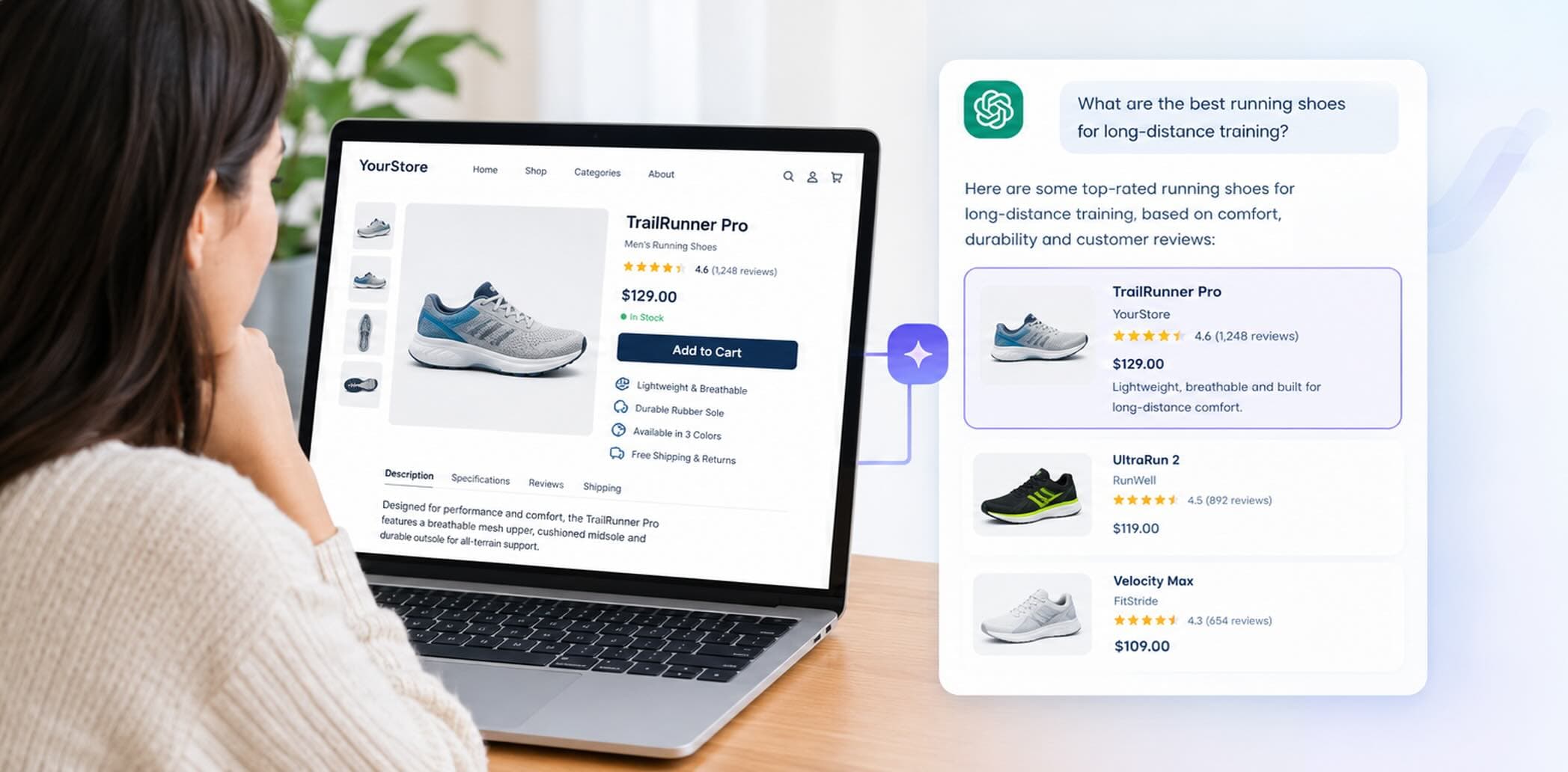
Shoppers no longer type three-word searches and click through ten tabs. They ask AI assistants complete questions: "Will this backpack fit a 16-inch laptop?", "Is this serum safe to use with retinol?", "Does this kettle shut off automatically?"
Questions like these can decide a purchase. If your product page doesn't answer them, an AI system has little reliable information to describe or compare your product.
In 2026, two changes made product FAQs more important, though many teams have read them the wrong way. Google retired FAQ rich results, and it introduced a product-level question-and-answer field built for AI shopping experiences. This guide covers what changed, where your product answers should live, and how to write FAQs that AI assistants can use.
What Changed for Product FAQs in 2026
1. FAQ rich results are gone. FAQ content is not.
Google stopped showing FAQ rich results in Search on May 7, 2026. Those were the expandable question-and-answer dropdowns that appeared under some listings. Google then removed the feature's documentation and reporting in stages over the following months.
Some teams concluded that FAQs no longer matter. That is the wrong conclusion. What Google retired was a display feature in search results. The FAQPage type is still valid Schema.org vocabulary, and answering buyer questions on your product pages is still useful content.
The rich result rewarded FAQs for taking up space on a results page. Product FAQs now matter for a different reason: they give people and AI systems clear, specific answers to real buying questions.
2. Product Q&A became a feed attribute for AI shopping
Google Merchant Center now supports a question_and_answer attribute. It is one of a set of conversational attributes that Google says are primarily intended for conversational experiences such as AI Mode in Google Search.
According to Google's Merchant Center documentation, the attribute:
- Is optional and can be used in all countries.
- Accepts up to 30 question-and-answer pairs per product.
- Allows up to 1,000 characters per question and 1,000 characters per answer, with a 10,000-character total per product.
- Should contain product information only. Prices, dates, and other time-sensitive offer details belong in their dedicated attributes.
- Should not be used for lists of keywords or search terms.
- Should not repeat information already submitted in the title, description, product detail or product highlight attributes.
For ecommerce teams, the signal is clear. Product-specific Q&A is now a structured input for AI-driven product discovery, not only a block of content at the bottom of a page.
3. Not every platform takes Q&A the same way
AI platforms collect product information differently. OpenAI's current product feed specification for ChatGPT covers core product data, pricing, availability, variants, returns, and review aggregates, but question-and-answer lists are not part of its standard discovery fields. When a platform's feed doesn't include your answers, your product page content has to.
The practical takeaway: don't put your product answers in only one place.
Why Product FAQs Matter for AI Visibility
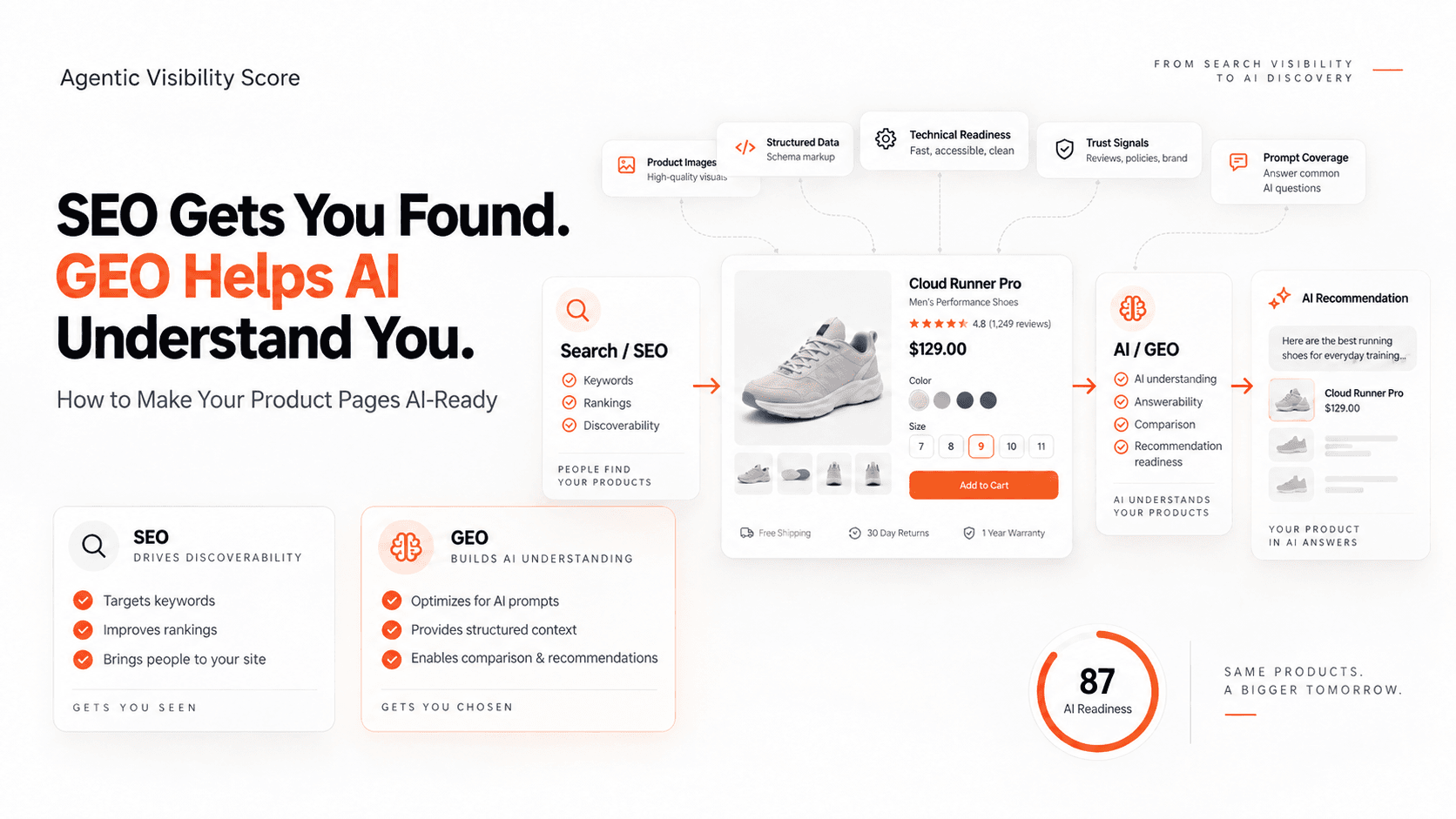
As our SEO vs GEO guide explained, AI-driven discovery depends on answerability: whether your product information can answer the specific questions a buyer is asking.
Product descriptions are usually written to persuade. They cover benefits, style, and brand story. Buyers' questions tend to be practical:
- Fit and size: "Will this fit a 6-inch wrist?"
- Compatibility: "Does this work with my existing charger?"
- Materials and ingredients: "Is this nickel-free?"
- Suitability: "Is this suitable for sensitive skin?"
- Use and care: "Can I put it in the dishwasher?"
- What's included: "Does it come with a carrying case?"
- Comparison: "How is this different from the Pro model?"
- After purchase: "What does the warranty cover?"
A well-built FAQ section fills the gap between what the description says and what buyers want to know. Each accurate, product-specific answer gives an AI system another fact to draw on instead of guessing or leaving your product out.
Where Your Product Answers Should Live
The strongest approach is to publish the same accurate answers wherever people read product information.
| Location | What it does | Key rule |
|---|---|---|
| Visible FAQ section on the product page | Answers shoppers directly and gives any system that reads the page clear question-and-answer content | Write it for people first; keep it specific to the product |
| Structured data on the page | Makes the product's identity, offers, ratings, and Q&A content easier for machines to interpret | Markup must reflect content visible on the page |
Product feeds (e.g., Google Merchant Center question_and_answer) |
Supplies Q&A pairs directly to AI shopping experiences that use the feed | No prices, dates, promotions, or keyword lists; don't repeat other attributes |
| Manuals, guides and support documents | Gives detailed technical, setup, and care information a source to point to | Keep documents public, current, and consistent with the product page |
Consistency matters most. If your product page says a bottle holds 750 ml, your feed says 24 oz, and your FAQ says "about 3 cups", you have created ambiguity that no AI system should have to resolve for you.
How to Find the Right Questions
The best FAQs are not invented in a brainstorming meeting. They come from questions customers already ask. Look at:
- Support tickets and live chat logs: the most direct record of pre-purchase uncertainty.
- Product reviews: customers often mention what they wish they had known before buying.
- Return reasons: "too small", "not compatible" and "not as described" usually point to a missing answer.
- On-site search queries: what shoppers search for while already on your product pages.
- Sales and customer service teams: the questions they answer every week.
- AI prompts in your category: ask AI assistants the questions your buyers would ask, and note where your product is missing or described inaccurately.
Then prioritize the questions most likely to affect a purchase decision. A question asked once a year about gift wrapping matters less than a sizing question behind 20% of your returns.
How to Write FAQs AI Assistants Can Use
Lead with the answer
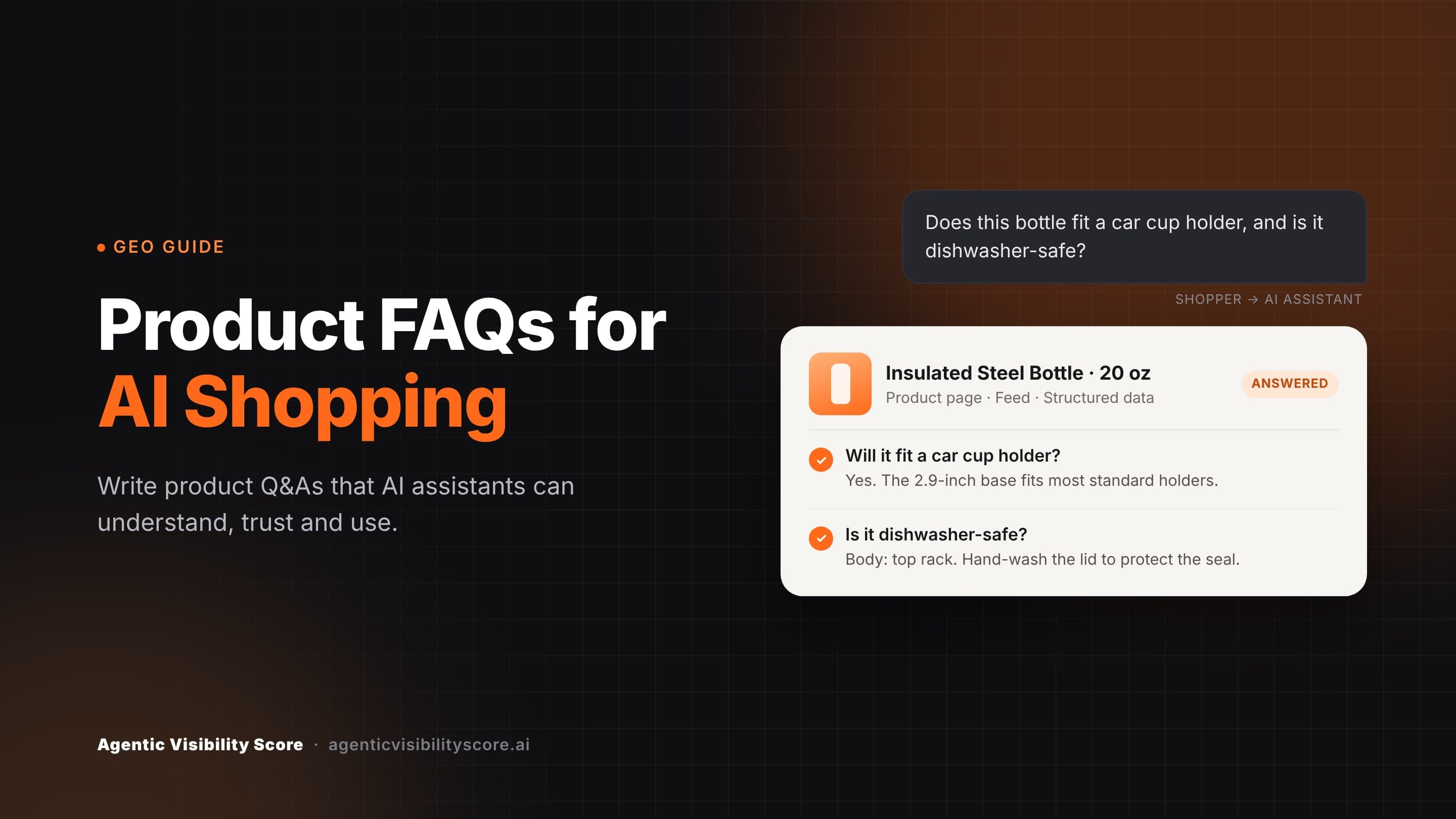
Put the direct answer in the first sentence, then add context. "Yes. The bottle is dishwasher-safe on the top rack" is more useful than a paragraph that only answers the question at the end.
Be specific and measurable
Use numbers, units, materials, model names, and conditions. "Fits most laptops" is vague. "Fits laptops up to 16 inches, with a padded sleeve measuring 15.4 × 10.6 × 1 in" is verifiable.
Keep each answer self-contained
An answer may be read on its own, without the surrounding page. Avoid answers like "See above" or "As mentioned in the description." Name the product or feature the answer refers to when it helps clarity.
One question, one topic
Don't combine sizing, shipping, and care into one long answer. Separate, focused pairs are easier for shoppers to scan and easier for systems to match to a specific question.
Keep time-sensitive details out
Prices, sale dates, promotions, and stock levels change often. Google's guidance for the question_and_answer attribute explicitly excludes them. Keep that data in the price and availability fields where it can be updated, and keep FAQs about the product itself.
Write answers, not keywords
An FAQ stuffed with search terms helps no one. Write the question the way a customer would ask it and answer it the way a knowledgeable salesperson would.
Only state what you can support
Never invent certifications, test results, compatibility claims, or comparisons. If an answer depends on conditions, state them. Inaccurate answers can mislead customers and can be repeated by systems that read them.
Weak vs. Strong: A Quick Example
Here is how the same questions might be answered for a hypothetical insulated stainless steel water bottle:
| Question | Weak answer | Strong answer |
|---|---|---|
| How long does it keep drinks cold? | For a really long time! | Up to 24 hours cold and 12 hours hot when the lid is fully closed, thanks to double-wall vacuum insulation. |
| Is it dishwasher-safe? | Easy to clean. | The bottle body is dishwasher-safe on the top rack. Hand-wash the lid to protect the silicone seal. |
| Will it fit in a car cup holder? | Fits most cup holders. | The 20 oz size has a 2.9-inch base and fits most standard car cup holders. The 32 oz size has a 3.6-inch base and may not. |
| Is it safe for kids? | Yes, perfect for the whole family. | The bottle is made from 18/8 stainless steel with a BPA-free lid. The straw lid is recommended for younger children because it is easier to drink from without spills. |
Strong answers are no longer for length's sake. Each one contains a fact a shopper or an AI system can use.
Common Product FAQ Mistakes to Avoid
- Copying the same store-wide FAQ onto every product page: generic shipping and returns questions don't help anyone understand a specific product. Keep store policies on a policy page and product FAQs on the product.
- Hiding FAQs in markup only: structured data should describe content that is visible on the page, not replace it.
- Repeating the description: if an answer only restates the description, it adds nothing. Use FAQs to cover what the description doesn't.
- Adding prices and promotions: these go out of date quickly and belong in offer and price data.
- Writing for volume: 30 shallow questions are less useful than 8 that answer real buying concerns.
- Publishing once and forgetting: products, variants, and customer questions change. Review FAQs whenever the product or its most common support questions change.
How Many FAQs Should a Product Have?
There is no ideal number. Google's Merchant Center attribute allows up to 30 pairs per product, but that is a limit, not a target.
A practical starting point is five to ten high-value questions for your best-selling and highest-margin products, focused on the questions that most often block purchases or cause returns. Expand from there based on what customers keep asking.
How Agentic Visibility Score (AVS) Helps
The hardest part of writing product FAQs is knowing which questions are missing. A page can look complete to your team and still leave important buyer questions unanswered.
Agentic Visibility Score (AVS) analyzes individual product pages for buyer prompt coverage: which discovery, comparison, trust, usage, and transactional questions the page answers, and which it doesn't. Based on those gaps, AVS recommends product-specific FAQs that you can review and add to your page. Shopify merchants using the AVS app can apply recommendations directly to their products.
After updating your product page, re-analyze it to see how its coverage and readiness change. Improve, re-check, and repeat.
An AVS score measures product readiness against the AVS framework. It does not guarantee how any third-party AI platform will display, cite, or recommend a product. It helps make sure your product information is ready when those platforms evaluate it.
Analyze your product with AVS and find the buyer questions your page isn't answering yet.
Final Thoughts
The end of FAQ rich results did not make product FAQs obsolete. It moved their value from appearance in search results to answering questions accurately.
AI shopping experiences are built around questions. Brands that answer real buyer questions clearly, specifically, and consistently across product pages, structured data, and product feeds give AI systems better information to work with, and give shoppers more reasons to choose them.
Start with the questions your customers already ask. Answer them well. Then measure whether your product pages are getting more complete. For a broader checklist, see our guide on how to improve product visibility in AI search.
Frequently Asked Questions
Is FAQ schema dead after Google removed FAQ rich results?
No. Google stopped showing FAQ rich results in Search on May 7, 2026, but FAQPage remains a valid Schema.org type. The visual feature was retired; the value of clear question-and-answer content on your pages was not.
Should I remove existing FAQPage markup from my product pages?
Not necessarily. Valid markup that accurately reflects visible content is generally fine to keep. Review it for accuracy instead: remove or update markup that describes content no longer on the page or answers that are out of date.
What is the Google Merchant Center question_and_answer attribute?
It is an optional product feed attribute for submitting product-specific FAQs as question-and-answer pairs. Google says it is primarily intended for conversational experiences such as AI Mode. Each product can have up to 30 pairs, with a 10,000-character total.
Should my product feed FAQs match my product page FAQs?
They should be consistent. The wording can differ slightly, but facts such as dimensions, materials, compatibility, and care instructions should match everywhere they appear.
Will adding product FAQs guarantee that AI assistants recommend my product?
No. AI platforms decide what to display and recommend based on many factors outside your control. Clear, accurate FAQs strengthen your product information, making it more complete and easier to understand when platforms evaluate it.